The Urban Garden. Experimental Laboratory for New Imaginaries
The Urban Garden. Experimental Laboratory for New Imaginaries
CALL FOR PAPERS
Deadline: 30 August 2026
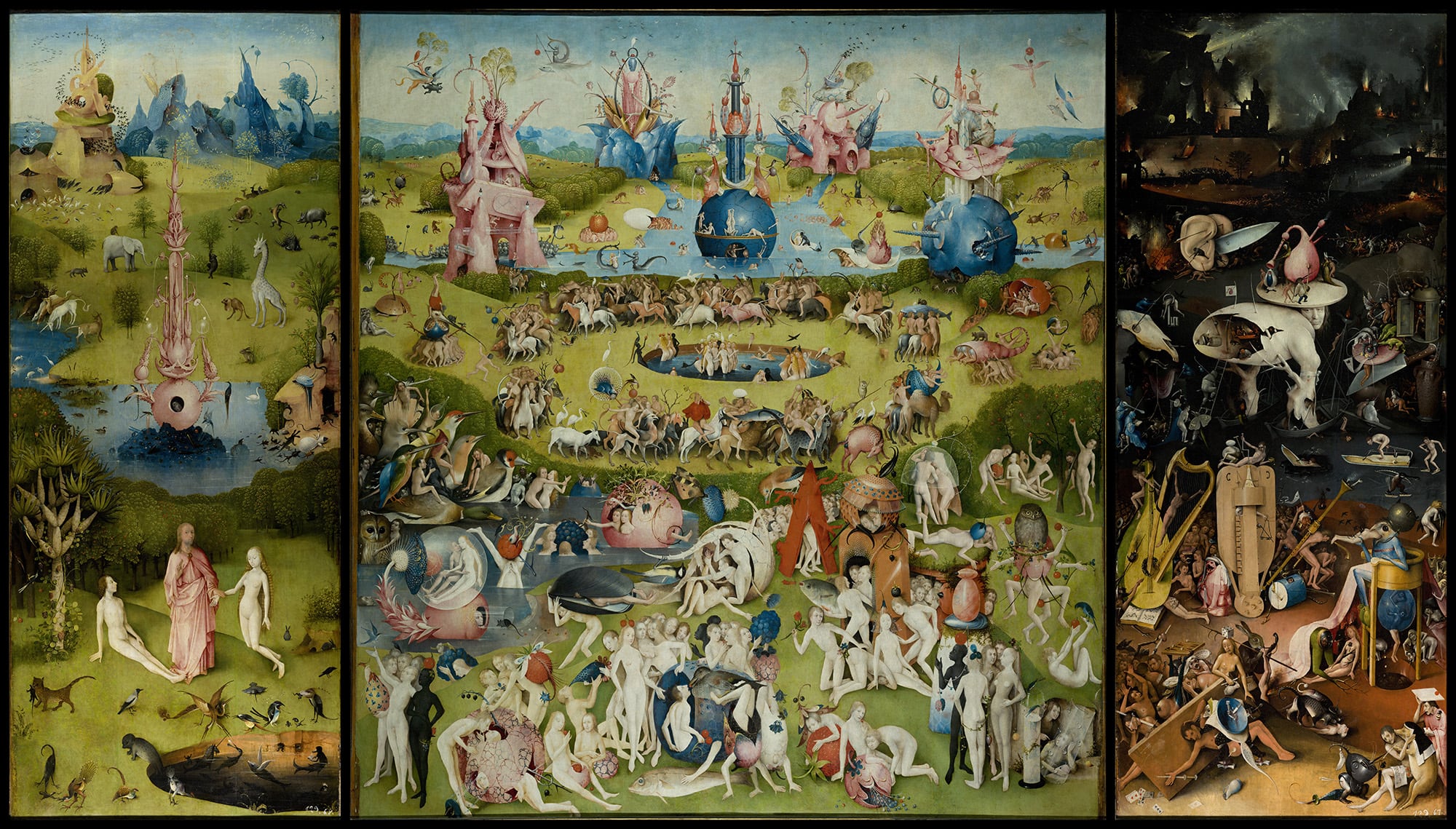
Image: Hieronymus Bosch, The Garden of Earthly Delights, c. 1490–1500. Museo Nacional del Prado, Madrid. Public domain, via Wikimedia Commons.
Throughout history, the garden has represented a threshold space between nature and artifice. Far from being merely an ornamental space, it has often served as a testing ground for new relationships between built space, living species, social practices and political imaginaries. The history of the garden can be interpreted not only as a history of forms and styles, but also as a history of cultural, technical and social systems through which societies have shaped their relationship with nature, the landscape, and the city (Teyssot and Mosser 1991).
Today, in the face of the climatic, environmental, economic and social transformations affecting the contemporary city, the urban garden is re-emerging as a strategic figure for conceiving alternative models of coexistence. It can be seen as an image capable of challenging the modern separation between architecture and agriculture, between city and countryside, and between the human and the non-human (Mancuso 2023). The garden can therefore be interpreted as a laboratory for urban and architectural experimentation, in which the tensions between the densified city and the landscape, between proximity and infrastructure, and between self-sufficiency and interdependence become visible.
From this starting point, the theme invites us to reflect on the garden both as a distinct element and as part of wider urban systems. The reference to the “city-archipelago” allows us to view the garden not as a residual fragment or a mere green respite amidst the built-up density, but as part of a constellation of voids, open spaces and thresholds capable of redefining the city’s form from within. Reflections such as those revived by Florian Hertweck and Sébastien Marot in “The City in the City. Berlin: A Green Archipelago” (2013), building on the manifesto drawn up in 1977 by Oswald Mathias Ungers and Rem Koolhaas, enables us to interpret the urban void not as an absence of design, but as a potential spatial, ecological and collective infrastructure, capable of forging new relationships between the disjointed parts of the contemporary city.
Alongside this interpretation, the theme of the urban garden can be linked to the historical experiences of productive gardens and urban self-sufficiency. The work of Leberecht Migge, in particular, demonstrates how the domestic and urban garden can be understood as a cultivable area and a technical means for food production. Through the slogan “Jedermann Selbstversorger!” (”Everyone a self-sufficient farmer!”), Migge proposed a reform of the modern garden based on the integration of home, land and agricultural labour, attributing a material role to green space in the construction of family and collective autonomy (Haney 2010; De Michelis 1991).
Within the field of studies on Public Life, the garden, on the other hand, becomes a possible manifestation of those urban elements that are essential for fostering life amongst buildings; when conceived and designed on a human scale, it takes the form of a shared space capable of catalysing movement, co-presence and social interactions (Gehl 2011). From this perspective, Christopher Alexander’s “generative grammar” of patterns provides a morphological framework for the design of positive open spaces, which organise relationships, calibrate the permeability between the private and public spheres, and dictate the metrics of proximity—essential for reactivating social dynamics within the city (Alexander 1977).
Gilles Clément interprets the garden as a symbol of the “enclosure” and “paradise”—a space in which every society identifies its “best”, selecting and preserving what it considers most precious. From this perspective, the garden embodies a particular vision of the world and the relationship between humankind and nature, which manifests itself within it and transforms over time. With the rise of ecology, the hortus conclusus has gradually been replaced by the idea of a garden in which the only enclosure is the biosphere, within which living beings share a finite space. The “Planetary Garden” is no longer an isolated, controlled fragment of nature but an open system of relationships among species and environments. The contemporary urban garden thus challenges the traditional opposition between nature and artifice, transforming design from a practice of domination and control into one of care (Clément 2013).
In this sense, the urban garden becomes a place where the tensions between densification and landscape, between proximity and infrastructure, and between self-sufficiency and interdependence are brought to light, opening up a broader reflection on mechanisms of resilience, forms of community, and the possibilities for reintegrating production into the urban environment.
This call is aimed at PhD students and researchers, inviting critical, historical, theoretical and design-based contributions that address the theme of the urban garden from interdisciplinary perspectives. Contributions are encouraged from the fields of architecture, urban planning, history of architecture, landscape architecture, philosophy, political ecology, social sciences, artistic and curatorial practices, and related areas of research.
Amongst others, proposals that explore the following themes will be accepted:
- The garden as an ecological system within the city
Design experiments focused on biodiversity, climate change mitigation and the creation of new relationships between the built environment and natural systems. - Garden as a space for care, community and knowledge
Care practices, therapeutic gardens, places for social interaction, participatory practices, campuses, botanical gardens, educational gardens and open-air spaces as places for learning, experimentation and new forms of shared living. - Garden as a place of urban production
Urban allotments, productive gardens, self-management practices, forms of self-sufficiency and new models for the production and sharing of urban space. - Garden as an urban project and part of the city’s collective imagination
Historical and contemporary case studies linking urban design and nature; representations, narratives and imagery of the garden in the historic and contemporary city.
This study day forms part of the activities organised by DESTeC PhD students and is situated within the research framework of Weird Science. Isolated Intelligence. Histories of Architecture, Technology and Evolution, a project by the Polit(t)ico Research Lab. In line with this perspective, the call aims to examine the urban garden as a place where techniques, devices, infrastructure, working practices and forms of organisation of collective life intertwine.
Essential bibliography
Alexander, Christopher. A pattern language: towns, buildings, construction. New York: Oxford University Press, 1977.
Charbonneau, Bernard. Le Jardin de Babylone. Paris: Gallimard, 1969.
Clément, Gilles. Jardins, paysage et génie naturel. Paris: Collège de France/Fayard, 2012.
De Michelis, Marco. “The Green Revolution: Leberecht Migge and the Reform of the Garden in Modernist Germany.” In The Architecture of Western Gardens: A Design History from the Renaissance to the Present Day, edited by Georges Teyssot and Monique Mosser, 409–19. Cambridge, MA: MIT Press, 1991.
Gehl, Jan. Life between buildings. Using public space. Washington: Island Press, 2011.
Haney, David H. When Modern Was Green: Life and Work of Landscape Architect Leberecht Migge. Abingdon: Routledge, 2010.
Hertweck, Florian, and Sébastien Marot, eds. The City in the City. Berlin: A Green Archipelago. A Manifesto (1977) by Oswald Mathias Ungers and Rem Koolhaas. Zurich: Lars Müller Publishers, 2013.
Jacobs, Jane. Vita e morte delle grandi città. Torino: Einaudi, 2009.
Koolhaas, Rem, and AMO. Countryside, A Report. Cologne: Taschen, 2020.
Mancuso, Stefano. Fitopolis: La città vivente. Roma-Bari: Laterza, 2023.
Marot, Sébastien, ed. Taking the Country’s Side: Agriculture and Architecture. Barcelona: Polígrafa, 2022.
Ponte, Alessandra, ed. Architecture, territoire, information 4.0: Les Îles-de-la-Madeleine: L’architecture face aux urgences planétaires. Montréal: École d’architecture, Université de Montréal, 2022.
Teyssot, Georges, and Monique Mosser, eds. The Architecture of Western Gardens: A Design History from the Renaissance to the Present Day. Cambridge, MA: MIT Press, 1991.
How to submit
Abstracts, written in English, must be no longer than 300 words and must be accompanied by:
- the title of the paper, no more than 65 characters including spaces;
- the author’s name, affiliation and email address;
- a brief biographical note of no more than 100 words;
- 3 keywords.
Proposals must be submitted by 30 August 2026 to theurbangarden2026@gmail.com
Timetable
- 06 July 2026: launch of the call for papers
- 30 August 2026: deadline for abstract submission
- 15 September 2026: notification of acceptance
- 26 November 2026: conference in Pisa
- 07 December 2026: submission of full papers
All deadlines are at 23:59 GMT+2.
Selected papers will be presented during the one-day conference. Following the conference, authors will be invited to expand their presentations into full papers for publication in the conference proceedings.
Organising Committee
Elisa Barsanti, PhD Student, UniPi
Federica Deri, PhD Student, UniPi
Francesca Molle, PhD Student, UniPi
Zhangliang Shuai, PhD Student, UniPi
Scientific Committee
Prof. Marco Giorgio Bevilacqua, University of Pisa
Prof. Nathan Brenu, Nantes Université
Prof. Valerio Cutini, University of Pisa
Prof. Silvia Dadà, University of Pisa
Prof. Giovanni Fusco, Université Côte d'Azur
Prof. Luca Lanini, University of Pisa
Prof. Lina Malfona, University of Pisa
Prof. Wang Meng, Shanghai Academy of Fine Arts
Prof. Alessandro Meloni, University of Pisa
Prof. Claudia Sansò, University of Trento